
When we think about aging well, we tend to think about how we look. How many wrinkles we have, how much grey hair is showing, how much weight we’ve gained and whether or not we look younger than our actual age, or better than Margaret, who is the same age as you.
But none of those things really tells us much about how well we’re aging.
Some of the best indicators of healthy aging are things we do every single day without giving them a second thought. From carrying groceries to getting off the couch, these seemingly ordinary tasks can tell us quite a bit about how well our bodies and brains are holding up as we get older.
But before we dive into the 10 things to prove you’re aging well, it’s important to note that you don’t have to train for hours a day and exercise till you feel like you’re passing out to age strong and healthy. There are some very simple exercises and daily activities you can do that will ensure you age well. I’ll share those, too!
10 signs you’re aging well and better than most
I used to think that my appearance was the deciding factor on whether or not I ‘looked good for my age,’ but at 64 years old, I’m realizing my looks have nothing to do with how well I’m aging. These 10 signs are what count.
You can get out of a chair without using your hands (or grunting!)
Getting off the couch used to be effortless, but somewhere along the way, many of us started needing a little extra push to get back on our feet.
Being able to stand up without pushing yourself off the armrests or putting your hands on your knees is a good indication that you still have decent lower-body and core strength.
The Centers for Disease Control and Prevention uses a 30-second chair stand test to assess leg strength and endurance in older adults. Take the test and see how well you did!
Those leg muscles are pretty darn important when it comes to maintaining your mobility, balance and independence as you age.
You still have a strong grip
Can you open a jar of pickles, carry a couple of heavy grocery bags or wring out a wet towel without much difficulty? I can, for the most part.
Believe it or not, grip strength can tell us quite a bit about how we’re aging. Researchers use it as one way to assess muscle strength and physical function in older adults.
We naturally lose muscle mass and strength as we get older, which is why some of those simple household tasks become more challenging.
If you’ve managed to maintain good grip strength, that’s something worth celebrating, and it means you’re aging well; if you’ve noticed yours declining, adding some simple strength exercises to your daily routine may help.
You might really like my recent video on my YouTube channel about how some things get harder after 60, one of them being grip strength!
You can still walk at a fairly brisk pace
You don’t have to power walk around the neighbourhood, but being able to walk at a comfortable, steady pace without struggling is a good sign.
Walking involves considerably more than just moving your legs. It requires balance, coordination, muscle strength, joint mobility and a decent level of cardiovascular fitness.
Researchers have even found associations between walking speed and longevity in older adults.
Of course, arthritis, injuries and other health issues can slow us down. The important thing is to keep moving in whatever way works for your body.
You still have good balance
Remember when putting on your socks or pants while standing up wasn’t something you had to think about? For many people, that gets a little trickier with age.
Good balance helps us navigate uneven sidewalks, step over obstacles, get in and out of the shower and go about our daily lives with greater confidence.
Interestingly enough, a 2024 study led by Mayo Clinic researchers found that the ability to balance on one leg was particularly revealing when it came to measuring age-related physical decline.
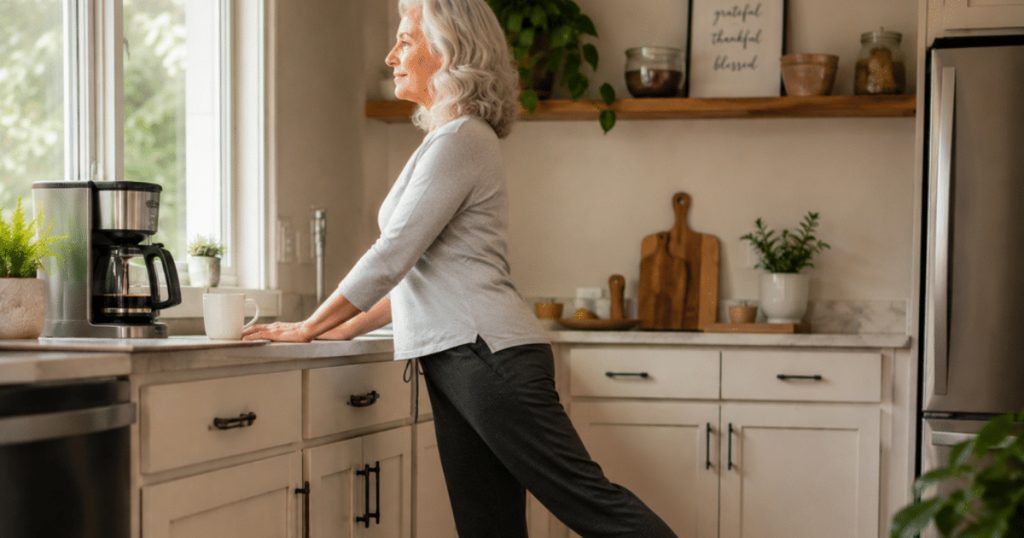
If your balance isn’t quite what it used to be, don’t despair. It’s something you can work on with safe, supported balance exercises. Here’s a great one-minute morning routine to help you improve your balance.
You can climb a flight of stairs without getting completely exhausted
Nobody’s expecting you to race up three flights of stairs without taking a breath, but if you can manage an ordinary flight of stairs without becoming excessively winded or needing a lengthy rest afterwards, that’s a good sign you’re aging well.
Climbing stairs is actually quite demanding on the body. Your heart, lungs and leg muscles all have to work a little harder to get you from the bottom to the top.
Maintaining that ability can make a big difference in your everyday life, especially if you want to continue travelling, exploring new places and getting around independently.
If you’re suddenly finding yourself unusually breathless doing things that were previously easy, though, don’t automatically chalk it up to getting older. It’s worth getting checked out.
You’re still able to learn new things
Maybe you’re learning a new language, figuring out how to use a new phone, taking an art class or teaching yourself how to play a musical instrument. The fact that you’re still able to take in new information, understand it and remember how to use it is an encouraging sign that you’re aging well and your cognitive health is great, too.
And by the way, forgetting where you put your glasses or walking into a room and forgetting why you’re there doesn’t automatically mean you’re losing your marbles.
According to the National Institute on Aging, learning new skills and participating in mentally engaging activities may help support brain health as we get older.
You’re certainly not too old to learn something new.
You still sleep reasonably well
Getting a good night’s sleep can become more challenging as we age. We might wake up more frequently, go to bed earlier or find ourselves wide awake at some ridiculous hour of the morning. Any of that sound familiar?
If you’re still getting enough quality sleep most nights and waking up feeling reasonably rested, that’s a good sign that you’re aging well. Sleep plays an important role in everything from memory and concentration to immune function, mood and heart health.
And despite what some people believe, older adults generally still need seven to nine hours of sleep a night. We don’t suddenly need less sleep just because we’ve reached a certain age.
If you’re struggling to get a good night’s sleep, try these tips:
- stop eating at least 3-4 hours before bedtime
- stop drinking anything at least 3-4 hours before bedtime
- stay off electronics right before you turn out the light to go to sleep
- make sure the room is not too hot or not too cold
You have a healthy appetite, and your weight is relatively stable
We spend so much of our lives worrying about gaining weight that we sometimes overlook the fact that unintentionally losing weight as we get older can also be a concern. Having a healthy appetite, eating a well-balanced diet and maintaining a stable, appropriate weight are all good indicators of aging well.
Getting enough protein becomes particularly important as we age because it helps us maintain muscle mass and strength.
You don’t need to follow some complicated diet or spend a fortune on supplements. Eating nutritious foods regularly and making sure you’re getting enough of what your body needs is a good place to start.
It’s also really important to note that your diet plays a huge role in your mental health as well. Poor diet and nutrition can lead to depression.
You recover fairly quickly after a busy or physically demanding day
Perhaps you’ve spent a few hours working in the garden, cleaning the house, walking around town or chasing after the grandkids. You’re tired at the end of the day, but after some rest, you’re feeling more or less like yourself again.
That’s an encouraging sign that your body is still coping well with the physical demands of everyday life and you’re aging well.
Recovering from strenuous activities can take longer as we age, and that’s perfectly normal, but maintaining the stamina to enjoy your usual activities without being completely wiped out for days afterwards is something to appreciate.
You can still handle the little tasks and chores of everyday life
Paying bills, remembering appointments, organizing your schedule, planning a trip, managing your money and figuring out what to do when something goes wrong all require a fair amount of brainpower.
Being able to plan, make decisions, solve problems and manage your daily responsibilities without becoming stressed or frustrated is an important sign that your thinking skills are serving you well!
It doesn’t mean you never forget anything or occasionally need help. People of all ages need help with things. It’s about retaining the ability to navigate everyday life, make informed decisions and adapt when things don’t go according to plan.
You don’t have to fear getting older.
You can age strong: body, skin, mind, and soul.
Click here to learn how with The NO BS Guide to Feeling Great After 60, rated 5⭐every time!!
Aging well has very little to do with looking young
Having wrinkles, grey hair, a few extra pounds, or the occasional aches and pains doesn’t mean you’re aging badly. We need to stop measuring how well we’re aging by what we see in the mirror and pay a little more attention to what our bodies and minds can actually do. Aging well has nothing to do with appearance.
And if you didn’t tick all ten boxes on this list, don’t beat yourself up. This isn’t a competition or a medical assessment. Genetics, health conditions, injuries and circumstances beyond our control all play a role in how we age.
The encouraging thing is that many aspects of healthy aging, including strength, balance, endurance and cognitive skills, can still be worked on later in life.
The goal isn’t to look 40 when you’re 65. It’s to be able to enjoy your life at 65, 75, 85 and beyond.
And that has absolutely nothing to do with how many wrinkles you have.