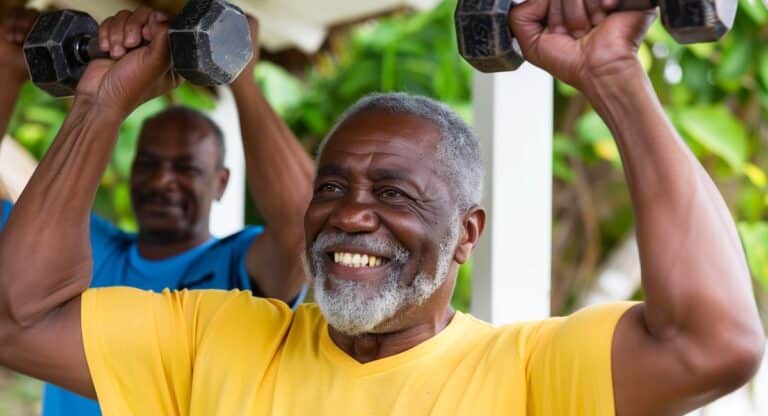


When I lived in Canada, I worked at our local YMCA as a health and fitness coach for adults over 60. One common concern most seniors have is that they want to stay strong but have limited mobility and simply can’t do the strength exercises they read about or think they ‘need to do’ to stay strong.
My job was to show them there are strength exercises for seniors with limited mobility that will help them feel strong, have more flexibility and balance and give them confidence, too.
Here are my top 10 chair exercises for seniors who have limited mobility.
You can check out my guide to aging strong and healthy here!
10 strength exercises for seniors with limited mobility
Before we begin, I have to say that sitting on a chair and doing exercises doesn’t make you lazy. Honestly, it’s the exact opposite! It means you’re trying, and that’s half the battle.
Get your best sturdy chair (or any chair, really) and become best friends with it. These strength exercises for seniors can be done on a chair or standing (depending on your limitations).
Strength exercises for seniors are one of the most effective ways to maintain muscle mass, improve balance, support joint health, and stay independent as we age.
Perform each movement slowly with control. Breathe out during the effort and in during the release. Start with 8–10 repetitions, and aim for 2 -3 sets. Always consult your doctor before beginning any new strength training regimen.
You can watch the exercises in action here in this YouTube video.
You might also really like this article on the best 20 bodyweight exercises, and if you’re thinking about starting strength training, this article will help you start safely!
Standing Wall Pushups
Stand facing a wall (feet about 12-18 inches away from the wall) with your feet hip-width apart and hands placed on the wall at shoulder height and slightly wider than your shoulders. Bend your elbows to lower your chest toward the wall, then push back to the starting position. Keep your body in a straight line from head to heels.
Standing wall pushups are excellent strength exercises for seniors that build upper body and core strength safely using the wall for support.
Seated Leg Extensions
Sit tall in a sturdy chair with your feet flat on the floor. Slowly extend one leg straight out in front of you until it is parallel to the ground, hold for 1–2 seconds, then lower it with control. Alternate legs.
Seated leg extensions are excellent strength exercises for seniors that strengthen the quadriceps and improve knee stability for easier walking and standing. They also help with lower back and abdominal strength.
Standing Leg Raises
Stand tall, holding onto the back of a sturdy chair or wall for balance.
- Side leg raise: Slowly lift one leg out to the side, keeping it straight, then lower with control.
- Back leg raise: Slowly lift one leg straight behind you, then lower.
Alternate legs. These standing strength exercises for seniors target the hips and glutes, which are crucial for balance and fall prevention. These also strengthen the lower back.
Seated Marching
Sit tall in a chair with feet flat on the floor. Lift one knee toward your chest as high as is comfortable, then lower it and alternate sides in a steady marching motion. Keep your core engaged throughout.
Seated marching is a simple yet effective addition to strength exercises for seniors, improving hip flexor strength and coordination.
Chair Squats (Sit-to-Stand)
Sit near the front edge of a sturdy chair with feet flat and shoulder-width apart. Lean slightly forward and stand up using your leg muscles. Pause briefly at the top, then slowly lower back down to sit. Use your hands on the armrests for support if needed.
Chair squats are one of the most functional strength exercises for seniors because they directly improve the ability to stand up from sitting.
Seated Upper Body Exercises (Bicep Curls, Shoulder Presses, Front Raises)
Sit tall in a chair holding light weights (or water bottles).
- Bicep curls: Palms facing forward, curl the weights toward your shoulders, then lower slowly.
- Shoulder presses: Start with weights at shoulder height and press them overhead, then lower.
- Front raises: Lift the weights straight forward to shoulder height, then lower with control.
These seated upper body strength exercises for seniors help maintain arm and shoulder strength for daily tasks like reaching and carrying.
Sit to Stand
This is a variation of chair squats. From a seated position, stand up fully using your legs, then sit back down slowly and with control. Focus on using your thigh muscles rather than momentum.
Regular practice of sit-to-stand movements ranks among the most beneficial strength exercises for seniors for maintaining lower-body power and independence.
Seated Ab Crunch
Sit tall in a chair with feet flat. Place your hands lightly behind your head or across your chest. Gently round your upper back and curl your shoulders forward toward your hips while engaging your abdominal muscles. Hold briefly, then return to upright. Avoid pulling on your neck.
This gentle version is a safe core strength exercise for seniors that helps improve posture and spinal support.
Heel to Toe Walk
Stand tall and place one foot directly in front of the other so the heel of the front foot touches the toes of the back foot. Take small, controlled steps forward while maintaining balance. Hold onto a wall or counter for support if needed. Do 8–10 steps.
Heel-to-toe walking is an outstanding balance and coordination strength exercise for seniors that helps reduce fall risk.
Seated Torso Twists
Sit tall in a chair with feet flat on the floor. Cross your arms over your chest or place your hands on your shoulders. Gently rotate your upper body to one side, hold for 1–2 seconds, then return to the center and twist to the other side. Keep your hips facing forward.
Seated torso twists are gentle yet effective strength exercises for seniors that improve spinal mobility and core rotation.
Final Thoughts on Strength Exercises For Seniors
Consistency matters more than intensity with strength exercises for seniors. Aim for 2–3 sessions per week. As you become stronger, you can increase repetitions or hold times.
These strength exercises for seniors can be modified further depending on your fitness level.
And remember, health is wealth, and it’s up to you to age strong and healthy. Don’t use your age or your limited mobility as excuses anymore!